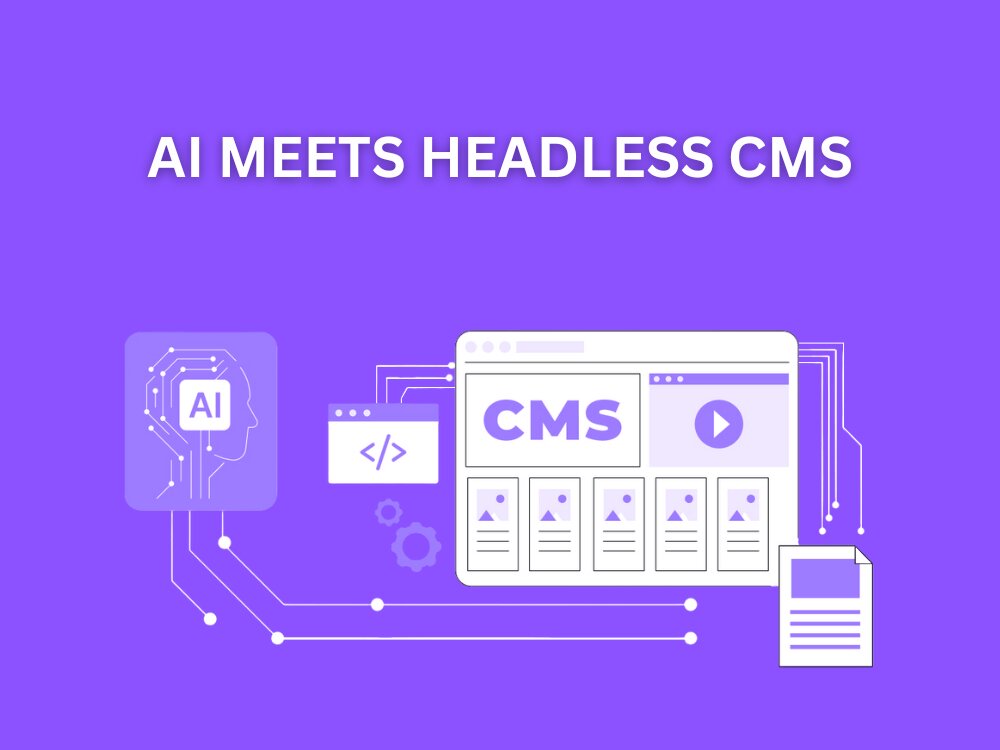
Is Your CMS Blocking AI Compatibility? Headless CMS Explained
While many businesses focus heavily on content, design and SEO, they often overlook one of the most critical parts of their digital infrastructure – CMS architecture. As AI-driven web interaction becomes more common, the limitations of traditional CMS architectures are becoming increasingly visible. Most traditional CMS platforms were designed primarily for human content publishing – not for machine-readable interaction, automation or AI execution.
This leads to the following question:
Does the CMS you are using limit your AI compatibility?
It is essential to understand how a headless CMS AI will interact with one another to create future-proof websites.
What is a Headless CMS?
A headless CMS is a content management system that separates content management from presentation, allowing content to be delivered across multiple platforms through APIs.
| Traditional CMS | Headless CMS |
| Completely integrated Limited flexibility Built with human consumers in mind | Use APIs to access content All components are decoupled Provides services via multiple devices for different types of users (web, mobile, AI) |
This approach is why headless CMS will result in successful implementations of AI compatible CMS environments. This decoupled architecture enables businesses to distribute content across websites, mobile apps, IoT devices and AI systems from a single centralized content source.
Traditional CMS and Its Limitations in AI Compatibility
Most legacy CMS platforms are not structured properly to allow for a successful AI implementation.
- User-Centric Architecture
- Content created and defined for the end user only
- Content is often not structured for machine readability or semantic interpretation.
- Limited User Access to API
- Access to the code layer can be restricted
- Restricted API access can limit how AI systems retrieve and process backend data.
- Many legacy CMS platforms also tightly couple frontend rendering with backend content storage, reducing flexibility for AI integrations and automation systems.
- Rigid Content Structure
- The overall structure of the information in a CMS is not flexible enough to accommodate the changing environment created by applications in an AI-enabled world.
- Lack of Data Standards
- Due to the varying formats of data in use, AI engines cannot accurately process the content of a CMS, creating confusion and ambiguity.
All of the above limitations restrict the effectiveness of AI as agents in automating and interacting with your content.
What are the Essentials That Make a CMS Compatible with AI?
AI compatible CMS must create content beyond just posting.
Important Features:
- API-first architecture – gives access to content with an API
- Data structure – provides machine-readable data structures
- Content delivery – Flexible delivery of the content
- Integration capabilities – Allow AI systems to access content, interpret structured data accurately and execute workflows efficiently.
A headless CMS AI is what you will require for this purpose. A modern AI-compatible CMS should also support structured metadata, semantic relationships and scalable API delivery.
Benefits of Headless Architecture for AI
There are many headless architecture benefits that are possible to use.
- API-first content delivery: This approach enables AI to interact with content.
- Structured content models: Provide better semantic clarity for machine usability
- Flexibility: Supporting integration of web, app & AI systems
- Scalability: Can remain flexible with new technologies and integration
- Performance efficiency: Optimized content delivery improves speed, scalability and system efficiency.
The above reasons are a prime reason why headless CMSs are the ideal platform for modern-day AI-driven ecosystems. Headless architecture also supports omnichannel publishing, allowing businesses to maintain consistent content experiences across human users and AI systems.
How Does Headless CMS Facilitate Interaction with AI on Websites?
AI relies heavily on structured, accessible data.
Using a headless CMS, the following are facilitated:
- Connections to obtain real-time data
- Delivering structured and machine-readable content
- Supporting seamless API connectivity
- Consistent data format
In the end, headless CMS enhances the way that AI interacts with your website by entering structured data inputs, providing predictable outputs and facilitating scalable workflows. Thus, a headless CMS provides the ability to convert all content into an AI-ready resource. This structure allows AI agents to retrieve accurate information faster while reducing ambiguity in interpretation.
Headless CMS + WebMCP: The Next Layer of Your Technology Stack
With headless CMS providing access to data, applications like WebMCP enable operationalizing that data.
Their combined stack consists of:
- Headless CMS = provides structured content
- APIs = provide access to data
- WebMCP = provides the execution layer that enables AI systems to discover, interpret and execute workflows
This results in a complete system where AI can:
- Understand how to use the content
- Retrieve and/or interact with the underlying data
- Execute a business activity using the above
This is the future of AI-compatible digital infrastructure.
APIs vs. Execution Layers
APIs provide access to structured data, while execution frameworks like WebMCP define how AI agents interact with workflows. For example, an API may expose booking information, but WebMCP enables AI systems to understand how to complete the booking process autonomously. Together, APIs and execution layers create AI-ready digital infrastructure.
When Should You Migrate to Headless CMS?
Not all companies will need to immediately migrate, but there are specific use cases that can benefit immensely from this change.
Examples include:
- Software as a service (SaaS) platforms
- Multi-channel retailers
- Content-rich websites
- AI-centric applications
- Enterprises with complex workflows
If your future success relies on scale and automation, a headless CMS will be a major strategic advantage for your organization.
Common Pitfalls When Moving to a Headless CMS
Moving from a traditional to a headless mode of operation will require an immense amount of detailed planning. Another common mistake is migrating to a headless architecture without redesigning content models for semantic consistency and AI usability.
Avoid the following pitfalls when embarking on your migration project:
- Migrating without a defined plan
- Neglecting to assess the content structure
- Developing poorly designed APIs
- Not aligning your development team with expectations
- Not having a plan for integrating AI
These types of mistakes will severely limit your ability to successfully implement headless CMS AI.
Effects of Headless Content Management Systems on SEO & AI
Headless CMS platforms such as Contentful, Strapi and Sanity can improve both traditional SEO performance and AI compatibility. Faster frontend frameworks, structured content delivery and scalable APIs make headless CMS platforms particularly effective for AI-driven search ecosystems.
Benefits of using a headless CMS for search engine optimization and artificial intelligence include:
Data Accessibility
- AI systems can access structured content via an API.
Content Flexibility
Headless CMS offers more options for scaling and adjusting dynamically to create effective SEO strategies.
AI Compatibility
Headless CMS allows for greater interaction and execution with AI systems.
Infrastructure to Support Future Search Ecosystems
Creating a platform that accommodates evolving search ecosystems.
In addition, the use of headless CMS is essential for modern SEO strategies.
FAQs:
A headless CMS is a content management system that separates the backend application (API) from the front-end application (such as a website) and makes the content available via an API.
A headless CMS provides structured content that APIs can easily access, which simplifies AI’s ability to retrieve structured data.
A traditional CMS is tightly integrated (coupled), whereas a headless CMS provides flexible platforms that are more API-driven.
Yes. A headless CMS enhances data access, scalability and is better suited to support AI-based search engine optimization.
If you want your website to work well with advanced AI interactions and provide business automation, it’s strongly recommended that you implement the use of a headless CMS.
Wrap up!
Your CMS will determine how well your site communicates with AI systems.
Most traditional CMS solutions fall short in three key areas:
- Data accessibility
- Content flexibility
- AI interaction capabilities
When you adopt a headless CMS AI, you will be able to:
- Deliver structured data to the web
- Create AI-compatible digital experiences
- Build scalable digital systems prepared for future AI ecosystems
AI will undoubtedly continue to change the web. The architecture and structure of the CMS you use will largely determine how well you compete with or grow alongside your competitors in the coming years.
Developing an AI-Compatible Content Infrastructure
Migrating to a headless CMS is more than a technical modernization project – it is a foundational step toward building AI-ready digital infrastructure. It represents a major strategic shift towards architecture built specifically for today’s and tomorrow’s AI.
At WebMCP, we assist businesses in designing and implementing their AI-compatible CMS ecosystems comprised of headless architecture, structured-data frameworks and execution layers powered by WebMCP technologies. Our approach guarantees that your content will be accessible and also optimized for AI interaction, automation and scalability.
If you are ready to move on from current legacy CMS limitations and move towards a system built for the future, now is the ideal time to take the next step.