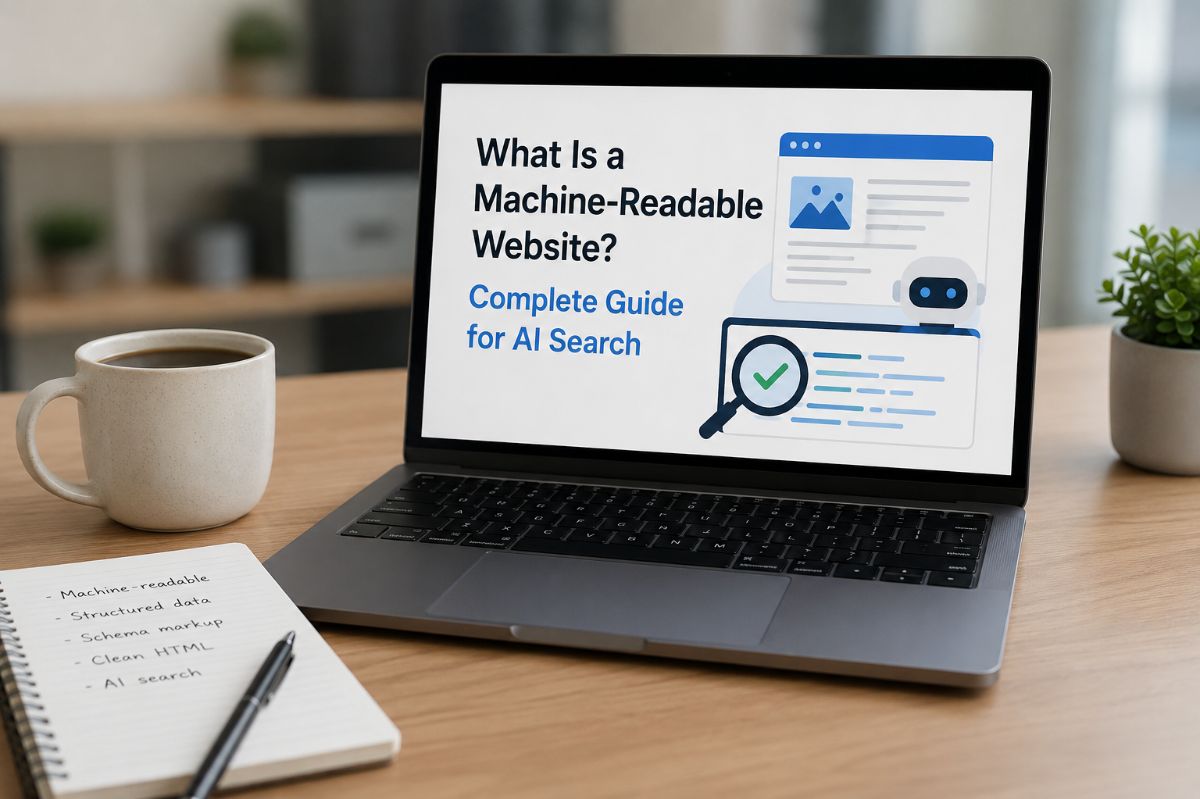
What Is a Machine-Readable Website? Complete Guide for AI Search
AI-powered search engines and smart digital assistants are changing the internet. Because of this, traditional SEO is no longer enough for businesses. Today, your website must be easy for humans to navigate and easy for machines to understand. This is why you need a machine-readable website.
A machine-readable website allows AI systems, search engines, web crawlers, and digital assistants to read, organize, and find your information instantly. Creating machine-readable content boosts your online visibility, helps people discover your brand, and keeps your business relevant in the age of AI search.
What Is a Machine-Readable Website?
A machine-readable website presents information in a structured format. This structure allows machines to understand your content immediately, without relying on visual design or human interpretation.
As an AI-ready website, it helps search engines, AI assistants, and autonomous agents understand and interpret information more effectively. It tells them:
- The Core Topic: Exactly what the content is about.
- The Connections: How different pieces of information link together.
- The Entities: Which specific products, services, topics, or brands you are discussing.
- The Context: How AI systems should interpret your data.
By organizing your site this way, you help search engines, AI assistants, and autonomous agents process your information accurately. As a result, these systems can deliver your content as the best answer to user queries.
Why Machine-Readable Websites Matter for AI Search
Traditional search engines ranked pages using keywords, backlinks, and basic content quality. These days, smart search tools dig into meaning by spotting links between ideas. Not just keywords anymore – context shapes results too. Meaning shifts when background changes. What matters gets clearer through patterns found across data.
A website thrown together without order makes it tough for AI tools to locate what you’ve posted. What happens next? Those systems pass right by, missing chances to spread your words further. A machine-readable website helps AI engines:
- Understand your page topics accurately
- Extract key information quickly
- Connect your brand with relevant topics and entities
- Generate reliable AI-powered answers
- Display your content in AI search results
As AI search grows, machine readability will decide how easily people can find your business online.
How Modern AI Search Platforms Understand Web Content
Today’s AI search platforms do more than just list web pages. Tools like ChatGPT, Google AI Overviews, Perplexity, and Claude need organized, machine-readable data to find and display your content.
These platforms analyze:
- Structured data and schema markup
- Content hierarchy and page organization
- Entity relationships
- Metadata and contextual signals
- Internal linking structures
Beyond AI assistants, autonomous search tools and AI agents now research topics, compare facts, and complete tasks for users. A machine-readable website helps these systems understand your content accurately so they can cite your brand in their AI-generated answers.
How AI Identifies Entities on a Website
AI search engines do not just look at keywords anymore. Instead, they focus on finding “entities”- the specific people, brands, products, organizations, locations, and concepts you mention across your content.
For example, when your website mentions a company, service, or product, AI systems try to figure out:
- What the entity is
- How it connects to other entities
- If it answers a user’s search query
- How authoritative and trustworthy it looks
To find and identify these entities accurately, AI systems look closely at:
- Structured data and schema markup
- Page titles and headings
- Internal links and how your pages connect
- Metadata and page descriptions
- Consistent details across multiple pages
When you clearly define these entities and their relationships, AI search platforms can understand your content easily and connect it to the right user searches.
Take a company that regularly shares posts on AI-driven search tweaks, sites built for machines, or structured data setup – over time, artificial intelligence begins tagging it as knowledgeable in exactly those areas.
6 Key Characteristics of a Machine-Readable Website
1. Structured Data
Structured data adds hidden code to your website. This code gives search engines and AI clear context about your content. By using structured data, you clearly explain your:
- Articles
- Products and Services
- Company details
- FAQs and Reviews
- Events
2. Schema Markup
Schema markup is a code you add to your website to help search engines understand your content. It gives search engines specific details about your pages so they can display your content with better, more attractive features in search results.
Common schema types include:
- Organization Schema
- Article Schema
- Product Schema
- FAQ Schema
- Review Schema
- Local Business Schema
Schema markup helps search engines and AI systems read your content easily. When these systems understand your site perfectly, they can rank your pages higher and show them to the right audience.
3. Clear Content Hierarchy
Machine-readable content follows a logical order. A well-organized page uses:
- Short, descriptive page titles
- A clear heading hierarchy (H1, H2, H3)
- Organized topic sections
- Simple navigation menus
This setup helps machines identify your main topic and supporting details instantly.
4. Semantic Content Organization
AI-readable websites focus on genuine meaning rather than repeating keywords. Instead of stuffing keywords into paragraphs, write naturally and cover topics completely.
For example, a page about machine-readable websites should naturally discuss:
- AI search
- Structured data
- Entity recognition
- Semantic SEO
- Knowledge graphs
These related topics tell the AI that you deeply understand the subject.
5. Entity-Based Content
AI systems track “entities” (specific concepts) rather than just individual words. Entities include:
- Brands and Products
- People and Locations
- Services and Core Concepts
A machine-readable website clearly identifies these entities and explains how they relate to each other. This helps AI build an accurate picture of your business.
6. Accessible and Fast Architecture
Machines cannot read your website if they cannot access your pages. Build a strong technical foundation by using:
- Clean, simple URL structures
- Updated XML sitemaps
- Strong internal links between pages
- Fast loading speeds
- Mobile-friendly designs
Traditional Website vs. Machine-Readable Website
By implementing machine-readable content, businesses can help AI systems better understand, interpret, and surface their information across AI-powered search experiences.
| Feature | Traditional Website | Machine-Readable Website |
|---|---|---|
| Primary Audience | Human visitors | Humans and AI systems |
| Content Structure | Designed mainly for readability | Designed for readability and machine interpretation |
| Data Organization | Often unstructured | Structured and semantically organized |
| AI Understanding | Limited context for AI systems | Clear context through structured data and entities |
| Schema Markup | May be missing or limited | Implemented across important pages |
| Entity Recognition | Not explicitly defined | Entities and relationships are clearly identified |
| Search Visibility | Optimized primarily for traditional search engines | Optimized for both traditional and AI-powered search |
| Content Discovery | Relies heavily on crawling and indexing | Easier for AI systems to discover and interpret |
| AI Search Readiness | Low to moderate | High |
| Future-Proofing | Focused on current search behavior | Prepared for AI assistants, AI agents, and emerging search technologies |
A traditional website only serves human visitors, but a machine-readable website talks directly to both people and AI systems.
Benefits of Building an AI-Ready Website
Higher AI Search Visibility: AI systems recommend content they can read and trust.
Faster Content Discovery: Structured data helps machines find your newest content quickly.
Better Search Engine Rankings: Clear contextual signals improve your traditional Google ranking.
A Future-Proof Business: Investing in machine readability today protects your traffic as search technology evolves.
Stronger Brand Authority: When AI systems consistently quote your content, your brand becomes a trusted industry leader.
How to Make Your Website Machine-Readable
Follow these steps to upgrade your website:
1. Add structured data to your most important pages.
2. Organize your content with clear, logical headings.
3. Write comprehensive content focused on topics and entities.
4. Improve your internal links and site structure.
5. Keep your metadata and page titles accurate.
6. Open your site to search crawlers and AI bots.
7. Audit your technical SEO regularly to catch errors.
FAQs:
To make your website truly search-engine friendly, you need more than just structured data. You also need clear content, well-defined topics, smart internal links, and a layout that’s easy for bots to navigate.
People grasp words that flow like conversation. Search tools need structure – neat rows, clear labels, predictable patterns – to pull out meaning fast.
Making a website ‘machine-readable’ means setting it up so AI and search engines can easily navigate and understand it. While tools like Schema markup help, it really comes down to organizing your topics clearly, using high-quality metadata, and building a site layout that bots can crawl without getting stuck.
Twice a year – or right after big changes – most companies need to check how well their website works for AI and machines. A fresh look keeps things running smoothly behind the scenes.
Businesses can prepare for AI search by using structured data, writing machine-readable content, connecting relevant topics, building a clean site layout, and opening their pages to AI crawlers.
Final Thoughts
A machine-readable website is no longer an optional technical upgrade. Online visibility demands effort from every company. When content gets sorted clearly, artificial intelligence can locate it more easily. Structure shapes how machines interpret what you offer. Sharing becomes smoother when details are arranged well.
Those who shift now gain reach, trust, fast movement. Change isn’t coming – already here, reshaping search. Smart moves today ride the wave instead of chasing it. Growth follows those tuning in early.
Ready to Prepare Your Website for AI Search?
Book a WebMCP readiness audit today. We will find your machine-readability gaps, boost your AI visibility, and turn your website into a powerful, AI-ready asset.