How to Measure WebMCP Success and AI Agent Engagement
Artificial intelligence is changing how people use websites. Instead of just reading pages, AI agents now find tools, complete workflows, submit forms, compare products, and handle tasks for users. This shift creates a new challenge for businesses: how do you know if your AI infrastructure actually works?
As websites move from standard pages to structured interactions, tracking success becomes crucial. Traditional SEO metrics like pageviews, clicks, and bounce rates no longer tell the whole story. Instead, WebMCP requires you to measure AI-driven actions and successful workflows.
This guide breaks down the essential metrics, KPIs, and tracking methods to help you evaluate your WebMCP performance and improve AI agent interactions.
Why Measuring WebMCP Matters
Traditional analytics platforms track human behavior. They measure:
- Page visits
- Session duration
- Click-through rates
- Conversion rates
- User journeys
AI agents, however, interact with your site differently.
Instead of clicking buttons or scrolling through menus, these agents find structured tools, read data schemas, and run automated workflows. WebMCP powers these interactions by turning your website’s capabilities into a format that AI systems can instantly understand and use.
Because of this shift, businesses need entirely new performance indicators. Without the right metrics, you cannot see:
- If AI agents can actually find your tools
- Which workflows agents use most often
- Where errors and system failures happen
- How successfully AI systems complete tasks
- If AI interactions actually drive your business goals
Key Metrics for Measuring WebMCP Success
Track specific, actionable metrics to bridge the gap between technical infrastructure and real business value. Focus on these five core areas to measure WebMCP success and optimize your site for AI traffic.
1. Tool Discovery Rate
This metric measures how often AI agents successfully find and access the tools on your website.
Tool Discovery Rate = Discovered Tools ÷ Available Tools × 100
A high discovery rate means you have:
- Clear tool definitions
- Easy-to-understand metadata
- Properly configured data schemas
If this rate is low, AI agents are struggling to understand what your website can actually do.
2. Tool Invocation Volume
Tool invocation volume tracks how frequently AI agents call specific tools on your site. Examples include:
- Product search tools
- Booking and scheduling engines
- Quote request forms
Tracking this volume helps you identify popular workflows, spot underutilized tools, and reveal emerging AI usage patterns. Over time, these engagement insights AI agent reveal exactly how AI systems prefer to interact with your website.
3. Workflow Completion Rate
Workflow completion is one of the most important indicators of WebMCP success. It measures whether an AI agent successfully finishes a task from start to finish, such as:
- Completing a booking
- Submitting a contact form
- Finalizing a transaction
Completion Rate = Successful Executions ÷ Total Attempts × 100
High completion rates prove that you have designed effective workflows and reliable tools.
4. Tool Execution Success Rate
Not every tool call succeeds. Some requests fail due to invalid parameters, schema mismatches, backend errors, or timeout events.
Tracking execution success rates helps you catch technical bottlenecks before they disrupt large-scale AI interactions. You should closely monitor successful executions, failures, and validation errors to keep your system running smoothly.
5. AI Agent Retention
Just as businesses track returning human users, you should monitor recurring AI interactions. AI agent retention measures whether agents repeatedly return to use your website’s tools.
A rising retention rate means your site offers reliable execution and highly useful tools. Low retention usually signals poor discoverability or broken workflows.
Monitoring Engagement Quality
Interaction Depth
Interaction depth measures how many actions an AI agent performs during a single session.
- Basic interaction: An agent finds a tool and runs it.
- Advanced interaction: An agent finds a tool, compares options, requests more details, and completes a complex workflow.
Deeper interactions mean AI agents find your site highly useful and engaging.
Multi-Tool Utilization
Advanced AI agents often combine multiple tools to complete complex tasks. For example, deploying a specialized AI agent for customer engagement allows the system to search for products, compare prices, request a quote, and schedule an appointment all at once. Tracking this multi-tool usage helps you evaluate if your WebMCP setup supports sophisticated workflows.
Ai agent for customer management
Measuring Business Impact
Technical metrics only tell half the story. You must connect AI activity to real business outcomes by tracking these three key KPIs:
- Lead Generation: Count how many inquiries, quote requests, and consultation bookings come directly from AI agents.
- Revenue Contribution: Track purchases, assisted conversions, and transactions that AI workflows generate.
- Operational Efficiency: WebMCP replaces messy visual scraping with clean, structured tools. This speeds up transactions, increases automation rates, and reduces your customer support workload.
Tracking Error and Failure Signals
To improve your system, you must closely monitor where things go wrong. Watch for these crucial failure indicators:
- Schema Validation Failures: These occur when AI agents submit incorrect data formats, miss required fields, or violate system constraints.
- Execution Timeouts: Workflows that take too long to complete signal performance bottlenecks in your system.
- Abandoned Workflows: Agents often start a process but stop before finishing. This usually happens due to missing information, poor workflow design, or backend failures. Analyzing these trends reveals clear optimization opportunities.
Building a WebMCP Analytics Dashboard
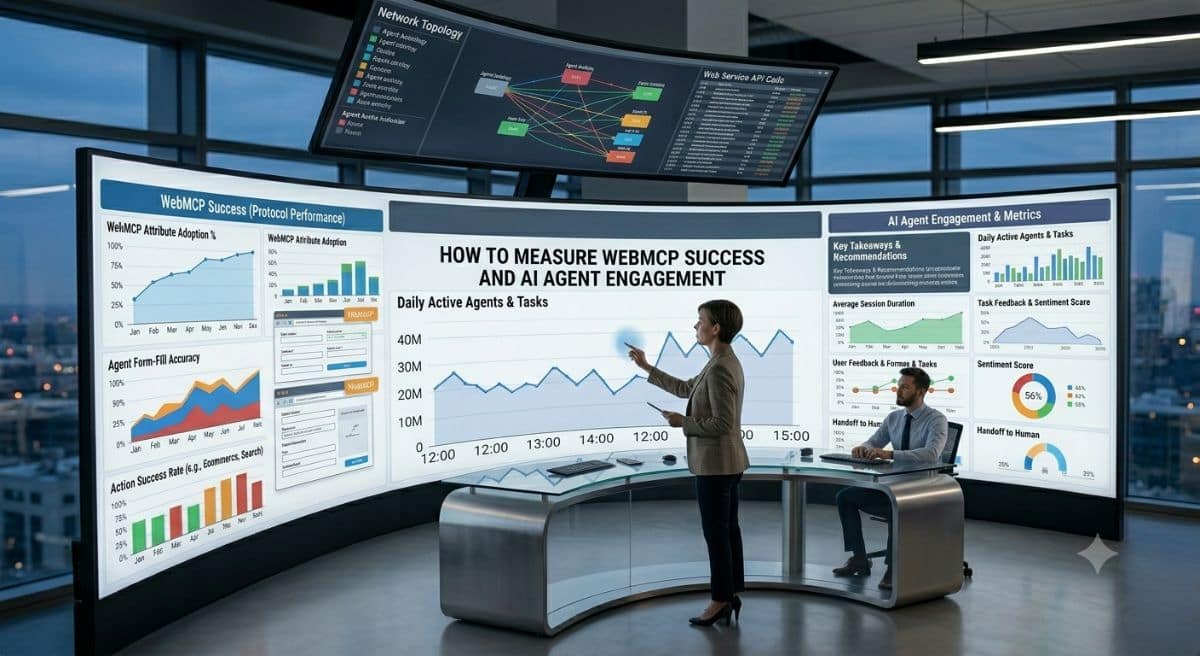
A great dashboard combines technical health and business growth in one view. Include these five sections to evaluate your performance:
| Dashboard Section | Key Metrics to Track |
|---|---|
| Discovery Metrics | Tool discovery rate, total available tools, and newly found tools. |
| Engagement Metrics | Invocation volume, interaction depth, and multi-tool utilization. |
| Performance Metrics | Execution success rate, workflow completion rate, and response times. |
| Business Metrics | Total leads generated, assisted conversions, and revenue impact. |
| Error Monitoring | Schema validation failures, timeouts, and abandonment rates. |
Future-Proofing AI Agent Measurement
As AI agents advance, analytics will move far beyond basic usage metrics. Future platforms will track intent completion, agent satisfaction, workflow attribution, autonomous transactions, and multi-agent collaboration.
Organizations that track these indicators today will optimize their AI interactions faster and adapt seamlessly to the growing role of intelligent agents. Ultimately, a well-structured machine-readable website builds the foundation you need for accurate tracking, clear workflow visibility, and reliable performance in an AI-powered web.
FAQs
WebMCP success measures how effectively AI agents find, access, and complete workflows through your website’s structured data.
AI agent engagement reveals how often intelligent systems interact with your website and how successfully they perform tasks for users.
The most critical metrics include your tool discovery rate, workflow completion rate, tool execution success rate, and AI-driven conversions.
Companies track this activity using specialized analytics dashboards that monitor tool usage, workflow speeds, system errors, and AI-generated business outcomes.
A machine-readable website translates your site’s capabilities into clean data schemas. This helps AI agents understand your tools instantly, run actions without errors, and finish tasks efficiently.
Wrap Up
Structured AI interactions demand a new approach to analytics. Traditional metrics cannot track how AI agents find tools and complete workflows. By monitoring discovery rates, execution success, and business impact, you can optimize your website for the fast-growing agent-based web and drive real business growth.
Unlock the Full Potential of AI-Ready Websites
Want to make your website accessible to AI agents? WebMCP helps you build structured, machine-readable web experiences that support AI-driven interactions, automated workflows, and future-ready digital engagement.