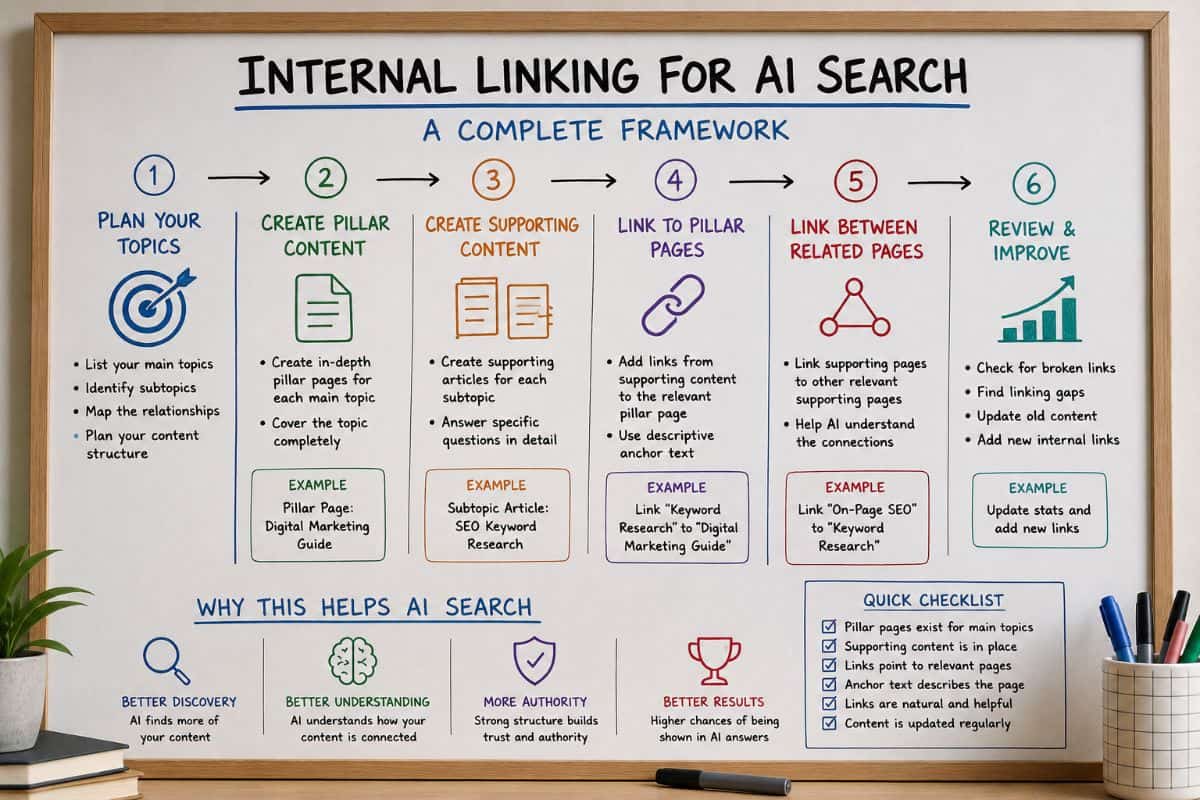
Internal Linking for AI Search: A Complete Framework
Search is changing fast. People now use AI platforms, smart assistants, and chatbots to find information. To keep up, you must structure your content for both humans and AI. That is where AI Internal Linking comes in.
Strategic internal links help AI systems map your website. They connect related topics, highlight your best content, and prove your expertise. While traditional SEO uses links for navigation, AI search uses them to build deep contextual understanding.
Use this guide to build a powerful linking framework that wins AI trust and boosts your rankings.
What Is AI Internal Linking
AI internal linking means strategically connecting your website’s pages so AI systems can easily understand your topics, context, and relevance.
Traditional search engines focus heavily on keywords and backlinks. AI search looks deeper. It maps how your ideas connect, tracks how information flows across pages, and evaluates whether you possess real subject-matter expertise.
Internal links build semantic pathways that guide AI crawlers through your knowledge ecosystem. For example, when you link pages about:
- AI SEO
- Structured Data
- Schema Markup
- Entity Optimization
- WebMCP
You signal to AI models that your website features a complete, authoritative topic cluster. This helps bots confidently trust and recommend your content to users.
Why AI Internal Linking Matters in the WebMCP Era
AI search engines do not just look at keywords; they map connections between your topics.
Clear pathways tell AI bots exactly how your content connects. By mastering Internal linking AI, you can link a page about WebMCP to posts on structured data or AI architecture to create a powerful topic cluster.
Stop relying on old SEO. Use smart internal linking to turn your separate pages into a trusted knowledge network that AI agents can easily find, trust, and recommend.
4 Key Benefits of Strategic Internal Links for AI Search
To rank well today, your website must serve both human readers and advanced machine learning models. Smart internal linking transforms isolated blog posts into a cohesive, searchable network that AI engines love.
1. Strengthens Entity Relationships
AI systems look at how your concepts relate, not just how you match keywords. Linking related pages helps AI crawlers map your parent topics, supporting articles, and content hierarchy. These clear connections prove to AI that your website offers deep, reliable expertise.
2. Improves AI Crawlability
AI crawlers explore websites by following links. Strong internal linking ensures that bots easily find your important pages, index new content faster, and eliminate “orphan pages” (pages with zero links). Without these pathways, valuable content stays hidden and disconnected.
3. Builds Machine-Readable Knowledge Networks
Modern AI search platforms reward complete topical expertise. A website with dozens of interconnected articles sends a massive signal of authority compared to a site with isolated, lonely pages. Your internal links create a web of knowledge that proves you know your niche inside and out.
4. Provides Semantic Context for AI Systems
Your link text (anchor text) gives AI engines vital context about the destination page. Stop using lazy links like “click here.” Instead, use descriptive phrases like “learn more about structured data implementation” so AI instantly knows exactly what the linked page discusses.
The Core Components of an AI-Driven Internal Linking Framework
An AI internal linking framework structures your content so search engines and humans easily navigate, understand, and index your pages.
1. Pillar Pages: Your Content Hubs
Pillar pages serve as comprehensive resources that cover broad, high-level topics. Think of them as the ultimate guides on your site.
Examples include:
- AI Search Optimization
- AI Website Architecture
- WebMCP Implementation (Your framework for unifying Web APIs and Model Context Protocol to give AI models direct, structured access to your content)
- Structured Data Strategy
These pages act as central hubs that connect all your related supporting content. Search engines and AI discovery engines use pillar pages to instantly identify the primary themes of your website.
2. Topic Clusters: Supporting Your Core Themes
Topic clusters consist of highly focused supporting articles that link directly back to your pillar page. This interlinked network creates a web of topical authority that search engines love.
Pillar Topic: AI Search Optimization
Supporting Articles:
- AI Internal Linking
- Entity SEO
- Schema Markup
- AI Crawlers & Content Visibility
This structure helps AI models understand exactly how your content pieces relate to one another. For instance, when you deploy a WebMCP architecture, your topic clusters build a powerful agentic SEO architecture that signals to AI crawlers which specific endpoints and guides support your main AI search strategy.
3. Contextual Links: Building Semantic Relevance
Contextual links sit naturally within the body text of your articles. They offer significantly more SEO value than standard header or footer navigation links because they provide immediate semantic relevance.
For example, an article about AI crawlers should naturally connect to related pages through semantic internal linking to tie together structured data, entity optimization, and website architecture. By linking these concepts inside the prose, you help AI systems map the relationships between your core content and your WebMCP integration points, boosting your visibility in AI-generated search results.
4. Hierarchical Navigation: Clearing the Path for AI
AI systems and search crawlers navigate your site more efficiently when you provide a clear, logical architecture.
A clean hierarchy typically looks like this:
Home → AI SEO →AI Internal Linking →Advanced Internal Linking Techniques
This clear path establishes definite content relationships and priority levels. It ensures that both human readers and AI agents can seamlessly crawl from your homepage down to your deepest WebMCP technical documentation without getting lost.
How Internal Linking Improves AI Crawlability
AI crawlers discover and understand your content by following the links across your website. A strong internal linking structure helps these crawlers find your most important pages, eliminates orphan content (pages with no incoming links), and creates clear pathways between related topics.
When you use descriptive anchor text and link relevant pages together, you provide immediate context about your content relationships, site hierarchy, and entity connections. These clear signals directly improve AI crawlability, strengthen semantic understanding, and help AI discovery engines map an accurate picture of your website’s expertise and topical authority.
The Future of Internal Linking in AI Search
As AI search evolves, internal linking matters more than ever. Future AI discovery engines will prioritize websites that master four key elements:
- Semantic relationships
- Entity connections
- Knowledge graphs
- Structured content ecosystems
Websites that organize their content around tightly interconnected topic clusters will capture far more visibility than sites with scattered, disconnected pages. Internal linking does more than just help users navigate your site. Today, it forms the bedrock of an AI-ready website architecture.
FAQs
AI internal linking connects related pages on your website so AI systems can easily understand how your content connects, spot your topic clusters, and recognize your website’s overall expertise.
Internal links create clear paths across your site. These paths help AI crawlers quickly discover new content, understand your site structure, and access your most important pages without wasting crawl budget.
Descriptive anchor text gives AI systems immediate context. Instead of generic links, descriptive words tell the AI exactly what topic and relevant information to expect on the linked page.
Topic clusters group related articles around one central pillar page. This setup proves your topical authority to AI systems and helps them see the semantic relationships between your pages.
It creates clear, logical content connections that AI models can read instantly. This structure directly improves your entity recognition, makes your content easy for AI to discover, and streamlines navigation across a WebMCP-ready website.
Final Thoughts
AI-powered search prioritizes context and expertise over keywords, making AI internal linking essential. By building pillar pages, topic clusters, and descriptive anchor text, you create an AI-friendly structure that boosts topical authority. Invest in a strong framework now to keep your content visible and competitive as search evolves.
Turn Your Website Into an AI-Readable Knowledge Hub
AI search heavily rewards websites that use architectures structured for machine understanding. By deploying WebMCP, you build a deeply connected, AI-ready framework that immediately improves crawlability, strengthens your entity relationships, and secures your long-term search visibility.