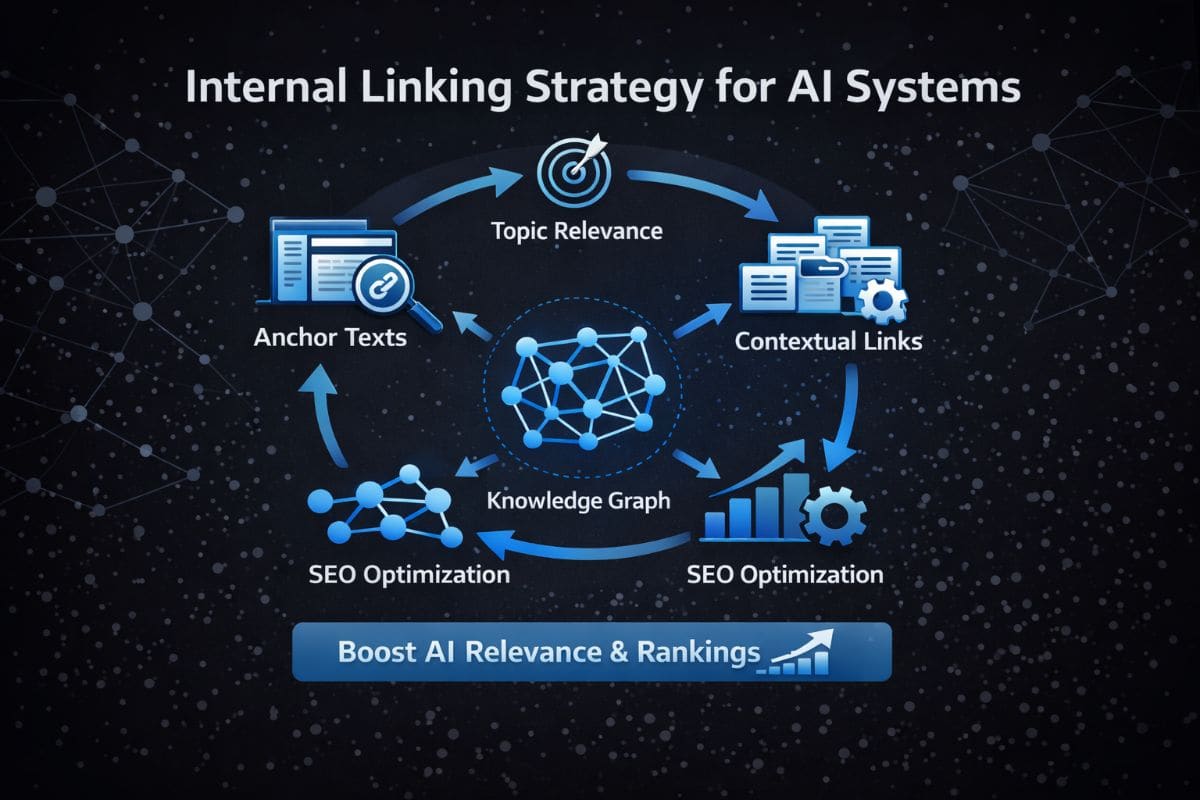
Ultimate Technical Guide to Internal Linking for AI Systems
Internal linking helps traditional search engines find and index your website. Today, AI search engines and autonomous agents change the game. They use internal links to understand your content’s true context, hierarchy, and user intent.
Because AI prioritizes meaning over simple keywords, a smart linking strategy is essential. Your internal links show AI models your topical authority and guide them to your most important pages.
This guide explains how AI-driven systems process internal links. You will learn actionable strategies to build a powerful, AI-friendly website architecture that boosts your rankings.
What is Internal Linking for AI Systems?
Internal linking AI refers to structuring internal links in a way that helps AI systems:
- Interpret the relationship among your various pieces of content
- Provide efficient navigation through your site’s architecture
- Understand content hierarchy and topical relationships
- Retrieve relevant information
Traditional internal linking primarily supports user navigation and PageRank distribution. The main purposes of AI-based internal linking are semantic clarity and structured connectivity.
Structured connectivity and optimized crawl paths are critical for effective AI interpretation. Ensuring that AI agents have a logical and efficient path through your website is a component of an effective internal linking strategy.
The Shift From Link Juice to Semantic Linking
Traditional SEO focused on distributing authority through links. AI systems, however, focus on meaning and relationships.
This section introduces the concept of a semantic linking strategy.
The Main Differences:
| Traditional Linking | AI-Focused Linking |
|---|---|
| Authority flow | Contextual relationships |
| Anchor text optimization | Entity clarity |
| Page ranking | Content understanding |
| Crawl depth | Crawl logic |
AI systems use internal links to build semantic relationships and knowledge graphs – not just evaluate rankings.
Principles Behind Internal Linking for Artificial Intelligence (AI)
Effective internal linking AI strategies are built around five core principles:
1. Entity-based linking connects related content through shared entities, topics and contextual relationships. An example of this is linking a service page to a related solution, blog content to a core topical enhancement and product pages to use cases. This helps AI systems understand semantic relationships across your website.
2. The logical crawl paths of AI systems. AI systems rely on predictable crawl patterns and logical navigation structures. There are also some best practices in this area:
- Shallow site depth
- Clear hierarchy
- Consistent linking patterns
These practices improve AI crawl path optimization by making content traversal more efficient and predictable.
3. Contextual relevance relates to how the links within the content context make sense. Internal links should be contextually relevant, strategically placed and connected to semantically related content. Each link should reinforce both the topic relationship and semantic meaning of the two topics.
4. Hub-and-spoke architecture is such that content should be organized into hubs and support related sub-pages. In the process of doing so, there should be a clear structure:
- The pillar page should be the primary topic of interest
- The cluster pages should support the pillar page with subtopics
This model creates a scalable semantic linking strategy that AI systems can interpret efficiently.
5. Consistent anchor text signals help AI systems clearly understand the meaning and destination of linked content. To back up this idea, there should be:
- Clear descriptive anchors
- Entity-based anchor text terms
- Consistent terminology to describe the relationship between the anchor text and the destination page
This helps AI systems better understand the link purpose and relevance.
Understanding How AI Crawl Paths Work
AI systems rely on crawl paths to discover, access, and understand the relationships between pages on a website. Unlike traditional crawlers that primarily focus on indexing content, modern AI systems analyze how pages connect to determine topic relevance, content hierarchy, and overall website structure.
Effective crawl path optimization helps AI systems:
- Discover important pages quickly
- Understand how related content is connected
- Recognize content hierarchy and topic clusters
- Identify high-priority resources within your website
To improve AI crawl paths, website owners should:
- Eliminate orphan pages that lack internal links
- Keep critical pages within a few clicks of the homepage
- Organize content using a clear parent-child structure
- Use logical internal linking between related topics
- Ensure all navigation and contextual links are easily accessible
When crawl paths are well-structured, AI systems can navigate websites more efficiently, build stronger semantic relationships between pages, and gain a clearer understanding of your content ecosystem. This ultimately supports better visibility, improved content discovery, and stronger AI interpretation and search performance.
How Internal Linking Works Within an AI Site Structure
Internal linking is foundational to an AI-ready architecture.
It connects:
- Semantic layers
- Structural hierarchy
- Data relationships
- Execution pathways
Together, these elements support AI understanding, navigation and execution.
When done properly, it will provide:
- Greater access to content.
- Strengthen semantic relationships between entities
- Allow for improved interpretation of the content using AI
This process makes internal linking AI essential to building machine-readable websites, as described above.
Common Internal Linking Mistakes for AI
Many websites do not update their linking methods to support the AI version of the site.
Things to avoid include:
- Creating links between semantically unrelated pages
- Placing too many links on a page
- Not linking to related entities
- Ineffective anchor text
- Using inconsistent or illogical site architecture
These issues will create confusion for AI and reduce its overall ability to interpret content and crawl websites effectively.
Advanced Internal Linking Techniques
When looking for deeper optimization, there are several advanced strategies you can use:
- Entity Clustering
Organize related content around shared entities and topical relevance. - Dynamic Linking System
Dynamically adjust internal links based on evolving semantic relationships between pages. - Workflow-Based Linking
Structure links around user journeys, workflows and interaction paths. - Connect WebMCP workflows to executable AI interactions
Link workflow to an executable tool for interaction with AI.
This combination of linking techniques provides additional semantic depth and execution readiness.
Advantages of AI-Optimized Internal Linking
To optimize internal linking AI, follow these foundational principles:
- Improve AI understanding of your website structure
The clearer the relationship between pages and content, the better an AI will be able to provide an interpretation of it. - Improve content discovery by AI
With properly constructed internal link structures in place, AI will locate and retrieve content more efficiently. - Improve SEO and AI-search visibility
Optimized internal link structures support search engines in both traditional and AI-generated query results. - Improve customer experience
An easy-to-follow internal link structure will lead to improved usability.
Utilizing these techniques sets internal linking apart as a strategic asset rather than a technical task.
Implementation Framework
The following is a step-by-step implementation framework:
- Audit the current internal linking structure for broken links, orphan pages and inconsistencies.
- Map semantic relationships between entities, topics and workflows. (i.e., identifying the connections of entities and creating topic-based clusters)
- Create an internal linking structure. (i.e., hub and spoke model)
- Optimize anchor text used for internal linking. (i.e., using clear and consistent terminology for linking)
- Simulate how AI systems navigate and interpret your internal linking structure. (i.e., simulating various methods for an AI to navigate through the internal links of your site).
These steps help ensure a robust and scalable internal linking strategy.
FAQs:
Internal linking AI is the practice of structuring internal links to help AI systems understand relationships between content and navigate websites efficiently.
Crawl path optimization is the act of optimizing the method associated with navigating to reach and interpret all areas of your website using an AI system.
Semantic linking focuses on creating connections between entities within a universe of meaning related to the entities and their context, while traditional linking relies on authority and ranking as the basis for linking.
Yes, internal linking allows for better discovery and interpretation of content by AI and increases the overall visibility of content created with the use of an AI engine.
Enhance internal linking by using entity-based linking, logical structure, consistent anchor text and semantic relationships.
Final Thoughts
Internal linking has evolved from a simple navigation tactic into a critical component of AI-ready website architecture. By creating semantic relationships, maintaining logical crawl paths, strengthening entity connections, and prioritizing contextual relevance, you help AI systems better understand and navigate your content.
As AI-driven search and autonomous agents become more influential, a strategic internal linking framework will be essential for improving visibility, discoverability, and long-term digital performance.
Create Internal Linking Optimised for AI with webMCP
Internal linking is more than simply part of your SEO strategy. It is a foundational architectural component that determines how AI systems discover, interpret and interact with your website.
At WebMCP, we create and implement AI-optimized linking strategies that are aligned with your semantic architecture, structured data and implementation layers of WebMCP. Our approach helps create websites that are not only discoverable but also executable within AI-driven ecosystems.
If you are ready to transition from traditional linking to building a system that will support AI use, today is the time to get started!