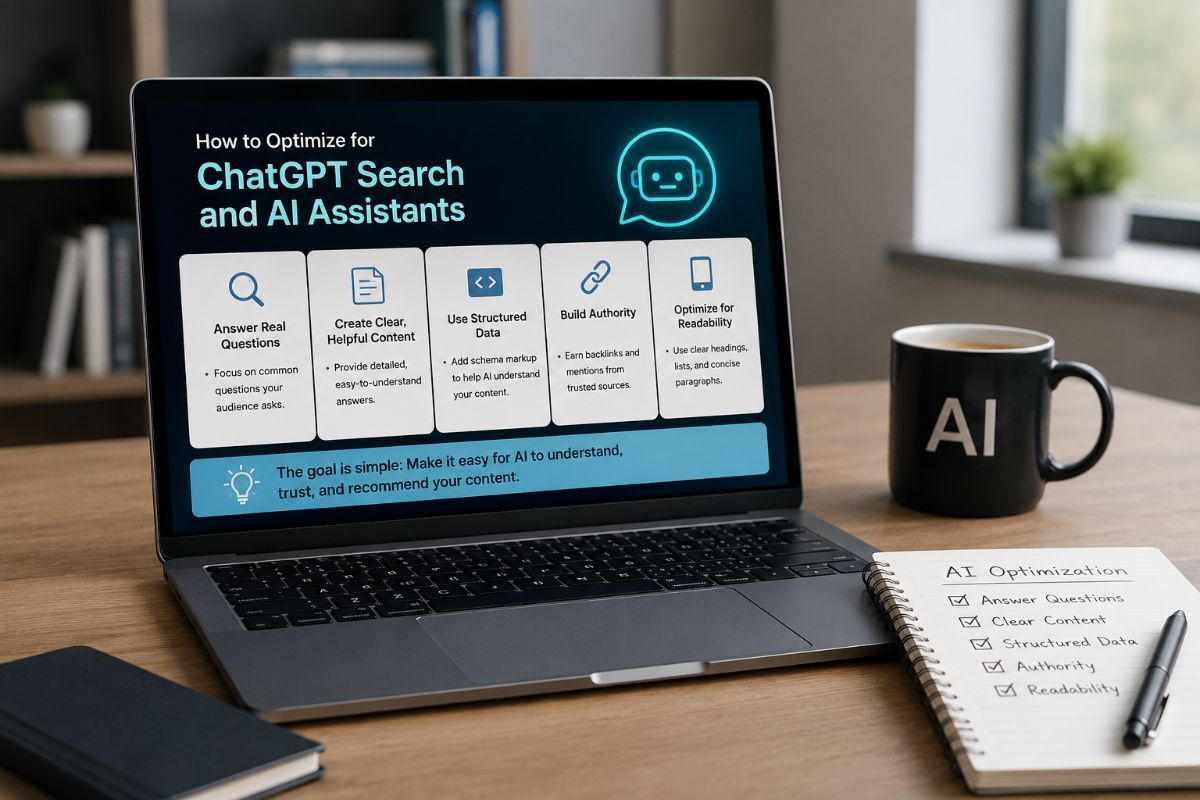
How to Optimize for ChatGPT Search and AI Assistants
Search is moving fast from traditional engines to AI assistants like ChatGPT, Gemini, and Claude. Instead of listing website links, these tools combine web data to answer users directly.
Because of this shift, online success no longer depends solely on classic SEO rankings. Instead, your business relies on whether AI systems can easily understand, trust, and cite your content.
To win the next phase of digital discovery, companies must learn how to optimize for ChatGPT search. Adapting your strategy now ensures these advanced platforms recognize and recommend your brand.
How WebMCP Fits into AI Search Optimization
Modern AI search tools need more than traditional SEO signals. They require structured, machine-readable layers to understand context, relationships, and meaning across your website.
WebMCP bridges the gap between your website and AI discovery systems. Instead of serving text only to human readers, WebMCP creates a structured layer that helps AI assistants immediately identify:
- What your page represents.
- How your content sections connect.
- Which entities and topics matter most.
- How to use your information in an AI response.
Future search visibility will depend on how effectively AI systems can parse your content, rather than just keywords or backlinks. WebMCP supports this shift by building an AI-friendly content environment, making it a foundational tool for businesses that want to rank in ChatGPT search and other AI assistants.
Understanding How AI Search Really Works
AI search systems do not rank pages the way traditional Google search does. Instead, they interpret content contextually by analyzing user intent, retrieving relevant data, and generating direct summaries.
This process shifts the focus of AI search optimization away from keyword density and legacy ranking factors. To succeed in this new landscape, you must prioritize absolute clarity, clean content structure, and deep topical authority.
Building an AI-Ready Content Strategy
Optimizing for AI assistants requires more than traditional SEO techniques. Your website must feature conversational, trustworthy, and structured content that AI systems can easily understand.
The following strategies will improve your visibility across ChatGPT Search and other AI-driven discovery platforms:
1. Optimizing for Conversational Search Behavior
AI assistants change how people search. Users now ask natural questions instead of typing short keyword phrases. When you write content that matches conversational intent, you help AI systems understand and deliver your information accurately.
2. Strengthening Trust Signals for AI Systems
AI models prioritize reliable, authoritative information when they generate responses. By building strong trust signals, you turn your content into a valuable source for AI-driven search experiences.
3. Structuring Content for Machine Extraction
AI systems extract specific sections rather than reading an entire webpage. When you organize your content into clear, focused sections, you improve machine understanding and increase your chances of accurate content retrieval.
4. Strengthening Internal Content Networks
AI search systems analyze the relationships between your pages to judge your expertise and topic depth. A strong internal linking structure builds a connected knowledge ecosystem that improves your content discoverability.
5. Keeping Content Fresh and Updated
AI search environments evolve constantly, which makes content freshness critical. Regular updates help you maintain accuracy, relevance, and long-term visibility in AI-generated responses.
Writing Content That AI Can Easily Understand
To improve your chances of appearing in AI-generated answers, you must structure your content for machine readability.
High-quality content tailored for SEO for ChatGPT usually includes:
- Clear Sectioning: Well-defined headings allow AI models to identify relevant segments quickly.
- Direct Explanations: Avoid indirect storytelling and focus on clear statements that answer user intent.
- Short Paragraphs: Concise text improves extraction accuracy for AI summarization models.
- Low-Ambiguity Language: Drop vague marketing fluff that adds no real informational value.
Your goal is simple: make it easy for AI systems to pull meaning directly from your content.
Why Structured Data Still Matters
Structured data plays a vital role in helping search engines and AI systems understand your website content. While AI assistants do not depend solely on schema markup, formats like FAQ, Article, and Organization schema provide valuable context that improves content interpretation.
In modern ChatGPT SEO strategies, structured data creates clear relationships between your information. This clarity makes it much easier for AI systems to categorize, understand, and use your content accurately in search responses.
Building Visibility Beyond Your Website
AI systems understand your brand by analyzing information across the entire web, not just from your website alone. Building a strong external presence improves your trust and recognition in AI search environments.
To strengthen your AI search optimization strategy, focus on these four actions:
- Earn mentions from authoritative websites.
- Publish valuable industry content on external platforms.
- Participate in relevant online discussions.
- Maintain consistent brand information across all platforms.
The more frequently your brand appears in trusted, relevant contexts, the stronger your overall AI visibility and digital authority become.
FAQs
Starting with how ChatGPT handles search, SEO now means shaping content so artificial intelligence grasps it fast. Understanding comes easier when structure supports machine reading. Retrieval improves if details are clear, not cluttered. Recommendations happen more often once systems trust what they find. Clarity leads to visibility in smart answers.
What happens when a machine tries to guess what you really mean? Older systems just match your words to pages they know, counting how often terms show up or who linked where. Smarter tools now look at why someone might ask something, reading between lines instead of scanning entries. Meaning matters more than matches these days.
Start by shaping clear, trustworthy text that talks back like a person who knows the answer. Build each part so machines grasp meaning fast yet sounds natural when read aloud. Answer straight without fluff just what the user came looking for. Let clarity lead while keeping things smooth and grounded in real talk.
True – when details are neatly arranged, machines grasp connections more clearly. Information gains shape through clear patterns instead of floating alone. Relationships between ideas become visible only once they’re linked on purpose. Clarity often follows when pieces fit by design rather than chance.
Out there, WebMCP builds a bridge machines can read, reshaping how artificial intelligence grasps what lives on your site. Instead of confusion, clarity emerges through structured links that guide each query with precision. Behind the scenes, data flows smarter, responding in ways that feel almost intuitive.
Final Thoughts
Optimizing for AI assistants means creating clear, structured, and trustworthy content that machines can easily understand. To effectively optimize for ChatGPT Search, you must focus on improving AI readability instead of chasing only traditional rankings.
As search evolves into a conversational experience, brands that adapt early will secure the strongest visibility in AI-driven discovery.
Book an AI Search Audit
Want to understand how well your website prepares for AI-driven discovery? Do you want to improve your visibility inside ChatGPT and other AI assistants?
Book an AI Search Audit today. You will identify exactly what holds your content back from ranking in the next generation of search.