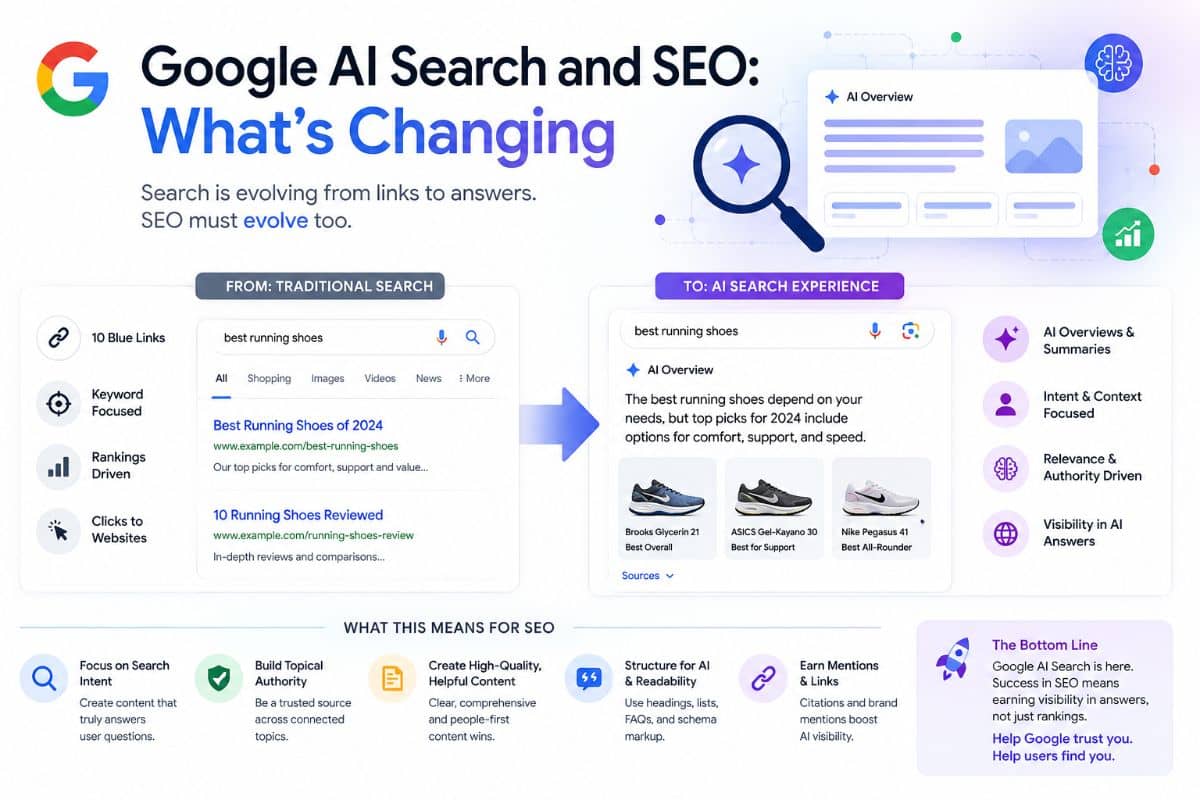
Google AI Search and SEO: What’s Changing
Has your website traffic been acting weird lately, even though your rankings seem great? Well, you are not imagining things. It is real. AI-powered Google search is flipping the game. People aren’t just clicking links anymore. They are querying directly in OpenAI to have the right answers. However, Google now tries to actually understand what users want. It serves up answers right on the search page. Therefore, businesses now like to take Google AI search SEO and SGE SEO strategy seriously and are adapting fast, while others may get left behind. If you dont want to stay behind, continue reading.
What is Google AI Search?
Google AI search is basically Google’s way of using AI to read the room. Instead of plugging in keywords and hoping for the best, AI-powered Google search looks for meaning, finds connections between topics and delivers relevant answers. This shift means businesses need to rethink how they build content, organize information and make their sites easy for machines to read – otherwise, you are invisible.
Why AI-Powered Google Search Is Reshaping SEO?
AI doesn’t just scan for keyword matches anymore. It looks for the story behind the page. Like: context, relationships between topics, structure and depth. Sites with well-organized headings and conversational explanations make things easier for Google’s AI to figure out. If your site’s clear and thorough, Google rewards you with better visibility.
How Google AI Understands Website Content
Most of us aren’t typing boring keywords anymore. We are asking full questions and expecting straightforward answers. That means content needs to sound like people talking – not robots. If your SGE SEO strategy centers on natural language and solving problems directly, you will fit right in. Write like you are helping real people, not just impressing an algorithm.
The Rise of Conversational Search Behaviour
The biggest change? AI-powered Google search now cares about how things are connected. It doesn’t just count keyword mentions. It checks if your site covers topics deeply and ties related ideas together. Sites that nail this are winning, while pages made just for keyword density are losing ground fast.
Why Semantic SEO Matters More Than Ever
The biggest change? Google AI search SEO now cares about how things are connected. It doesn’t just count keyword mentions. It checks if your site covers topics deeply and ties related ideas together. Sites that nail this are winning, while pages made just for keyword density are losing ground fast.
Structured Data Is Becoming Essential
Structured data and schema markup help Google’s AI figure out what your site’s really about. It lets you define things like articles, products, services and FAQs in a way a machine can understand. Add the right schema (FAQ, article, organization, product and service) and you cut out confusion, helping Google highlight your information in AI-generated answers.
Traditional SEO vs. Google AI Search SEO
Traditional SEO still matters, but priorities are shifting. Here is how things shake out now:
| Traditional SEO | Google AI Search SEO |
|---|---|
| Focuses on keywords | Focuses on meaning and context |
| Optimizes rankings | Optimizes AI interpretation |
| Targets clicks | Targets answer visibility |
| Uses metadata heavily | Uses semantic relationships |
| Search engine focused | User and AI-focused |
The future? You will need a mix of both approaches.
How Businesses Should Adapt Their SEO Strategy?
To adapt, start creating content that’s clear, structured and conversational. Build semantic organization, cover topics thoroughly and make your info easy to read. Internal linking is crucial – it helps AI connect the dots between pages. Here is what to focus on:
- Cover topics deep and wide
- Answer questions ASAP
- Link your pages intelligently
- Add schema markup for structure
- Stick to solid technical SEO
All this helps you stay visible as Google’s AI keeps evolving.
Common SEO Mistakes in AI Search
Lots of businesses are stuck stuffing keywords or publishing thin content – these tactics kill your credibility in AI-powered Google search. Pages built only for rankings without real value are slipping. Another red flag: using too much AI-written content without editing for clarity or originality. Google rewards true expertise and clear explanations.
Industries Facing the Biggest Impact
SaaS firms, agencies, healthcare, legal and ecommerce – they all rely on online visibility. AI-powered Google Search can now sway buyers and build trust before someone ever lands on your site. That’s why these industries are heavily investing in smarter SGE SEO strategies.
Quick Action Plan for AI Search Optimization
If you want to boost your Google AI search SEO, start simple:
Step 1: Improve content clarity
Write conversationally and answer user questions directly.
Step 2: Strengthen Semantic Structure
Organise information with headings and related topics.
Step 3: Add Structured Data
Add schema markup for structure.
Step 4: Improve Technical SEO
Keep pages fast and mobile-friendly.
Step 5: Build Topic Authority
Build authority by publishing deep and consistent content.
Even small tweaks can help you show up more often in AI searches.
What is Next for Google AI Search?
AI-powered Google search keeps changing. Pretty soon, AI answers might pop up everywhere – from voice assistants to shopping carts. The businesses that jump in early will have a big head start, especially if their websites are ready for semantic search and conversational discovery.
The folks adapting now aren’t just coping – they are shaping the future of how people find things online.
FAQs:
It is optimizing your site for Google’s AI-driven search – where semantic understanding and direct, helpful answers matter most.
It means crafting your content for Google’s Search Generative Experience, so it appears in AI-generated search summaries.
It pushes context, content depth and clarity to the forefront – not just keyword placement.
Definitely, it lays your technical foundation, but now you need AI-centric strategies too.
Yes. Schema markup makes your site easier for Google’s AI to understand and promotes your content in AI-powered answers.
Final Thoughts!
AI-powered Google search is making online competition tougher. Google AI search SEO is now more conversational and context-driven. If you only stick to old ranking tactics, you will likely get left behind as AI search evolves.
But, if you focus on semantic optimization, write genuinely helpful content and build a strong SGE SEO strategy, you will boost your visibility, authority and stay ahead in an AI-first world.
Get Your Website Ready for AI Search
The future of SEO depends on how well your site talks to both people and machines. Make your content organized, clear and readable – both by humans and AI. You will have the edge! As an AI-powered Google search keeps evolving, sites that focus on conversational clarity and accessibility will win the battle for attention, trust and conversions.
There are companies like WebMCP that are professionally working on Google AI search SEO. Therefore, if you need assistance regarding an AI-powered Google search, you must look for professional help.