How to Optimize for ChatGPT Search and AI Assistants
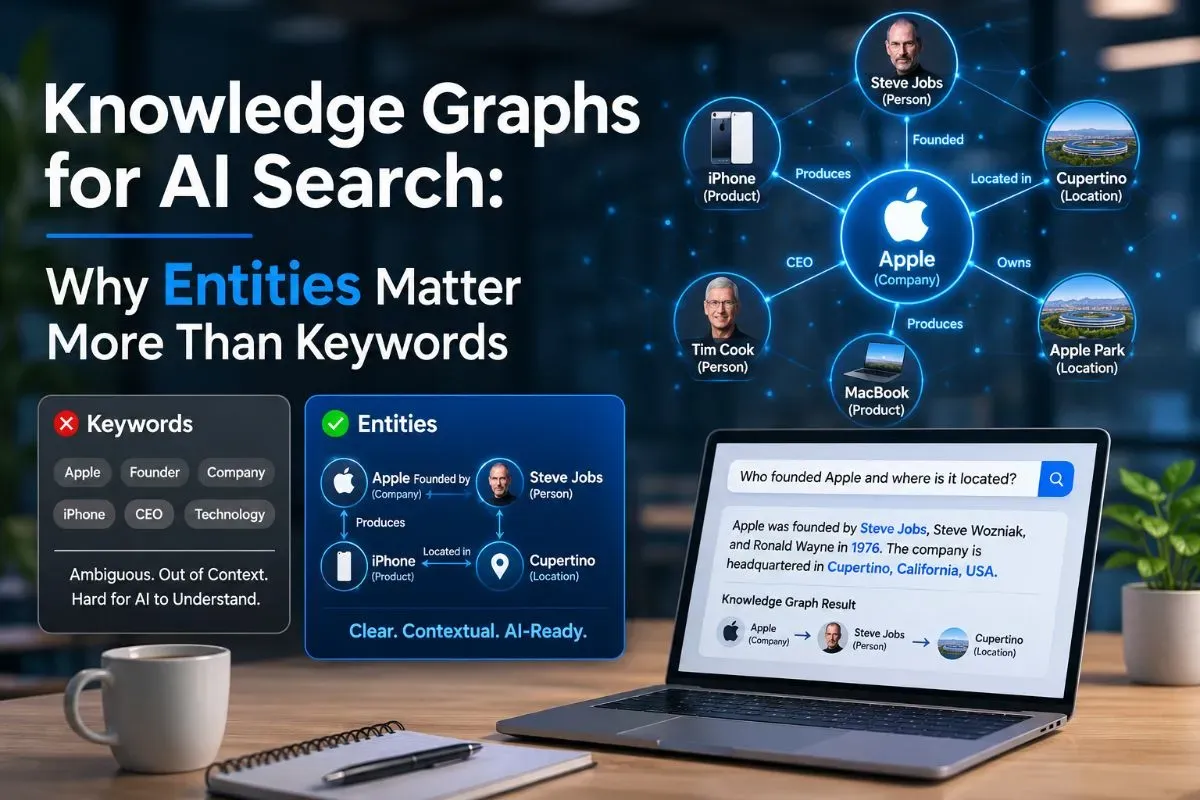
AI search now prioritizes entity understanding over traditional keyword matching. For years, brands relied on keyword optimization and backlinks to rank. Today, AI systems analyze the actual meaning behind words, identifying specific entities and mapping their connections.
Consequently, knowledge graph SEO serves as a critical strategy. When you clearly define your brand identity, services, and expertise, AI search engines easily understand and recommend your website. Shift your focus from isolated keywords to structured entity relationships to maximize your modern search visibility.
What Is Knowledge Graph SEO?
Knowledge Graph SEO optimizes your website so search engines and AI systems can truly understand your business entities and their relationships.
Instead of just tracking repeated keywords, a knowledge graph builds a structured information network using three core elements:
- Entities: Distinct data points representing your company, products, services, people, locations, technologies, or concepts.
- Relationships: The meaningful connections that link these entities together.
- Attributes: Specific details that provide extra context for each entity.
How It Works in Practice
Consider this clear chain of connections:
WebMCP World
→ provides → AI Search Optimization Services
AI Search Optimization
→ improves → AI Search Visibility
AI Search Visibility
→ supports → Digital Brand Growth
By explicitly defining these connections, you help AI search engines grasp exactly what your business represents, significantly boosting your modern search visibility.
Google’s Knowledge Graph: Understanding Entities Beyond Keywords
Google’s Knowledge Graph allows search engines to understand real-world entities rather than just matching isolated keywords.
When users search for a recognized brand, organization, or person, Google displays a knowledge panel. This visual block aggregates trusted details like business descriptions, official websites, social profiles, and key corporate attributes.
Google analyzes key digital signals like your official website content, structured data markup, brand mentions, and connected assets. Optimizing these signals establishes a clear digital identity, helping search engines accurately map the relationships between your brand, services, and industry topics.
Why Keywords Alone Are Not Enough for AI Search
Traditional SEO relied heavily on keyword targeting. Brands repeated specific terms like “AI SEO agency” or “AI marketing services” to rank. Today, AI systems ignore keyword stuffing and evaluate deeper quality signals:
- Context & Meaning: The actual depth and purpose of your content.
- Topic Relationships: How well your topics connect to broader industry themes.
- Brand Authority & Expertise: Your proven credibility within your niche.
Instead of counting words, AI systems now ask vital questions:
What does this company do? Who do they help? Why does this brand deserve trust?
How Entity SEO Powers AI Search
Entity SEO solves this challenge by connecting your brand directly to relevant concepts. Instead of chasing isolated keywords, businesses deploy semantic SEO to build a network of clear entity relationships:
AI SEO Agency
→ offers → AI Search Optimization
AI Search Optimization
→ includes → Knowledge Graph SEO
Knowledge Graph SEO
→ improves → Entity Understanding
These semantic relationships help AI systems grasp the complete meaning of your digital footprint. To build these strong connections, you must optimize five core signals:
- Comprehensive Topic Coverage: Addressing a subject thoroughly.
- Structured Data: Using clean schema markup to define your data.
- Internal Linking: Connecting your pages logically.
- Content Relationships: Creating a clear hierarchy of ideas.
- Brand Consistency: Maintaining uniform information across the web.
Stronger data connections allow AI search engines to instantly identify your expertise and confidently recommend your business.
The Technical Side: How AI Decodes Entities
Modern search engines move beyond exact text matching by deploying advanced algorithmic technologies:
- Natural Language Processing (NLP) & Machine Learning: Core systems that analyze human language patterns.
- Vector Embeddings: Mathematical representations that calculate the semantic similarity between different phrases.
For example, vector models recognize that AI Search Optimization, Generative Engine Optimization, and AI Visibility Strategy share deeply related concepts despite using different words.
Transforming Text into Structured Data
To map meaning, AI applications execute two critical steps: Named Entity Recognition (NER) and Entity Linking.
First, NER identifies and classifies key data points within your content.
Sentence: “WebMCP World provides AI Search Optimization services.”
- WebMCP World → Organization Entity
- AI Search Optimization → Service Entity
Next, Entity Linking connects these discovered entities directly to global knowledge databases. This two-step process allows AI systems to comprehend the true meaning of your content rather than relying on superficial keyword matches.
Why Entity Relationships Matter for AI Answers
AI search engines generate answers by evaluating how well concepts connect. When users ask for specific solutions – like finding companies that improve AI visibility – search bots instantly assess brand authority, service offerings, and topical relevance.
Websites that build strong, explicit entity relationships send clearer data signals to search crawlers.
This clear structure helps AI systems easily grasp your core business expertise, which directly increases your chances of appearing as a trusted source in AI-generated answers.
The Role of Semantic SEO in Knowledge Graph Optimization
Semantic SEO builds comprehensive content around complete topics instead of isolated keywords. A strong strategy covers the main subject, relevant terminology, and user questions. For example, discussing AI Search Optimization requires covering AI agents, knowledge graphs, and structured data.
Integrating these layers helps businesses implement entity SEO to prove topical authority, giving AI systems the clear data signals they need to rank your website.
How to Build a Knowledge Graph SEO Strategy
1. Define Your Core Entities
Identify the essential data points that define your business ecosystem. Pinpoint your core brand, primary services, key products, target industries, and specific audience pain points. Once identified, clearly map how these distinct entities connect to one another.
2. Create Supporting Content
Build comprehensive content clusters around your main subject matter to establish deep topical authority.
- Main Entity: AI Search Optimization
- Supporting Entities: Knowledge Graph SEO, Entity SEO, Semantic SEO, AI Search Visibility, and AI Crawlers
3. Use Structured Data
Implement schema markup to provide search engines with clear, machine-readable details about your organization, services, articles, and products. For example, use clean JSON-LD code to explicitly define your business assets:
Example:
{

  "@context": "https://schema.org",

  "@type": "Organization",

  "@id": "https://webmcpworld.com/#organization",

  "name": "WebMCP World",

  "url": "https://webmcpworld.com/",

  "serviceType": "AI Search Optimization"

}
This explicit code strengthens entity recognition and ensures search crawlers accurately catalog your data.
4. Build Internal Entity Connections
Use a strategic internal linking structure to establish clear relationships between your web pages. Connect your broader foundational topics directly to your specialized guides:
Example:
AI Search Optimization Page
→ Knowledge Graph SEO Guide
Knowledge Graph SEO Guide
→ Entity SEO Strategy
These deliberate internal links create a highly visible, structured website ecosystem that AI engines can effortlessly crawl and understand.
The Future of SEO Is Entity-Based
The future of search shifts completely beyond keywords toward a deeper semantic understanding. AI engines must recognize your brand identity, your exact service offerings, and how your data connects with broader industry concepts.
While traditional keywords merely display words on a page, entities explain their actual meaning. By deploying smart strategies like entity SEO, businesses build a resilient digital footprint. Ultimately, your core goal involves transforming your website into a trusted, highly visible entity that AI systems can effortlessly understand and recommend.
FAQs
Knowledge Graph SEO helps AI systems understand distinct entities, real-world relationships, and core brand information rather than just matching isolated keywords.
Entity SEO enables search engines to map your brand, services, and expertise directly to relevant industry concepts, which drives better AI-powered recommendations.
Yes, keywords remain relevant, but modern AI search engines prioritize deep context, underlying entities, relationship mapping, and overall semantic understanding.
Businesses can maximize their visibility by deploying structured data schema, maintaining consistent branding, publishing authoritative content, and building strong entity relationships.
End Note
AI search fundamentally transforms modern SEO by shifting the focus from keyword optimization to deep entity understanding. Businesses that prioritize Knowledge Graph SEO, Entity SEO, and semantic relationships drastically improve how AI systems recognize and recommend their brands. Ultimately, building a clear, robust entity presence serves as the definitive key to future-proofing your digital visibility in the AI era.
Build Your AI Search Visibility Strategy
Maximize your website’s search visibility by mastering Knowledge graph SEO and Entity SEO. Contact WebMCP today to schedule your expert consultation.