AI Search Era: UX is No Longer Just for Humans
Today, search engines do more than just help people find information. As AI search tools and smart assistants grow, you must build your website for both humans and machines. AI needs to read your content, understand your menus, and see what actions people can take. This understanding helps AI deliver accurate answers and complete tasks.
A good user experience (UX) shows AI that your website is clear, relevant, and easy to use. When you build a great site for your visitors, you also give AI exactly what it needs to understand, recommend, and interact with your pages.
How WebMCP Improves AI Website Interaction
AI agents are changing how we use the internet, but most websites only cater to human visitors. Humans navigate pages, click buttons, and complete tasks manually. AI agents, on the other hand, need structured data and clear instructions to understand what a website can do.
WebMCP bridges this gap. It allows websites to share clear actions and workflows that AI systems can easily understand and execute. Instead of forcing AI to guess based on visual layouts and text, WebMCP helps agents identify available tools, know exactly what data to input, and complete tasks faster.
When you combine clear human design with WebMCP, you create a website that both humans and AI systems can easily navigate, understand, and use.
What Are UX Signals in AI Search?
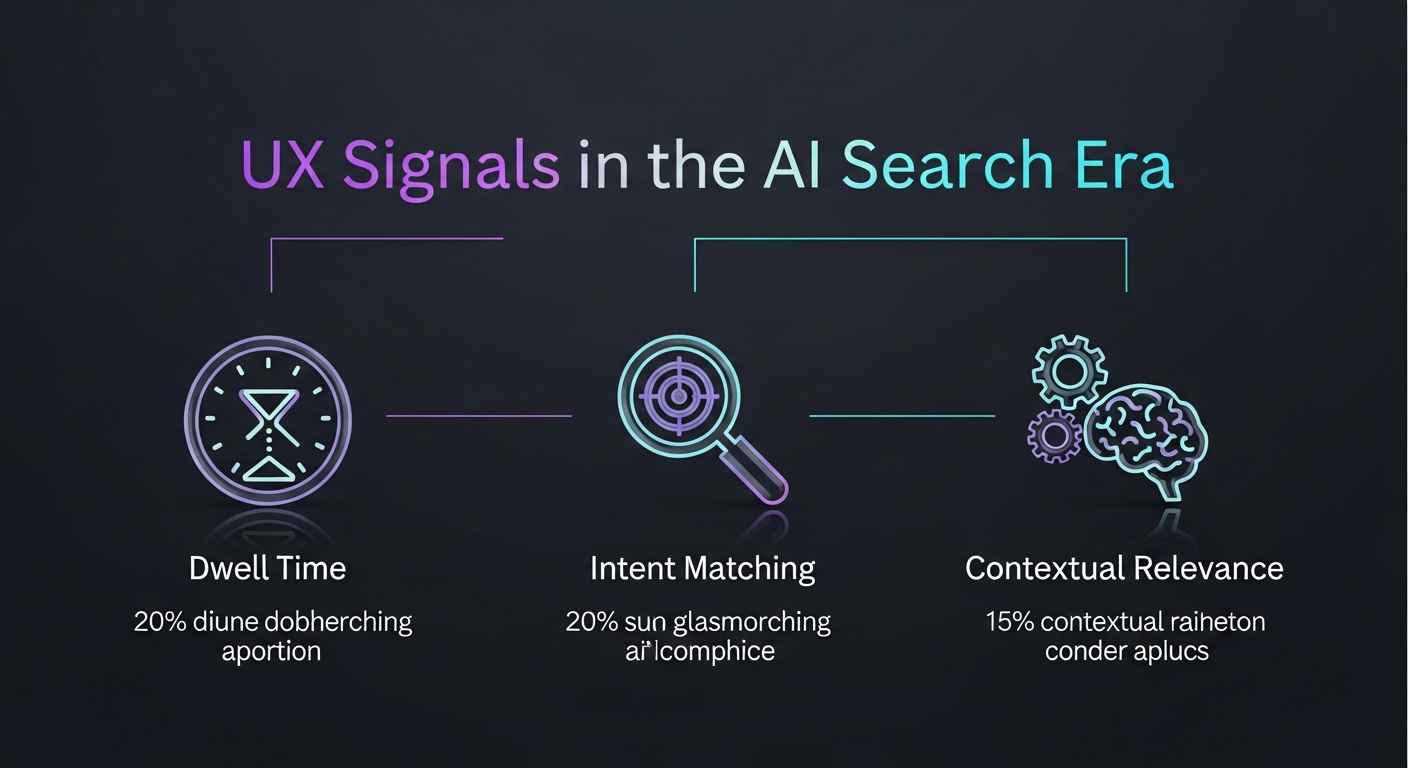
AI user experience signals refer to behavioral and engagement data used to evaluate how users interact with websites, including:
- Engagement metrics
- Interaction patterns
- Behavioural data
- Content satisfaction
Compared to traditional SEO metrics, unlike traditional SEO metrics, UX signals focus on user satisfaction, engagement quality and interaction patterns – not just clicks.
For example:
- How long users spend on a web page
- Depth of interaction with the website
- Patterns associated with users’ navigation
- Task completion rates for the users
These signals help AI systems understand whether content genuinely solves user problems or simply attracts traffic. The various user interaction signals will provide an AI system with the data it needs to assess. If the information contained within the content of any website is meaningful, relevant and actionable to the user.
The Transition From Ranking to Engaging with Users
Traditional search engines primarily focused on:
- Looking for keywords
- Finding relevant links
- Matching content to users
Now, with AI powering search engines, AI-driven search systems now prioritize:
- Insights from behavioral data
- User satisfaction
- Behavioural patterns
As a result of this shift, engagement in AI search will be a critical point of differentiation.
Why Should This Matter
AI systems aim to deliver the best possible answers and experiences – not simply lists of links. User engagement signals help AI determine whether content is useful, actionable and worthy of greater visibility.
Example: Making Website Actions Clear for AI
Traditional websites rely on visual buttons and layouts:
<button>Book Now</button>
While humans instantly understand this button, an AI agent struggles with it. The AI doesn’t know what “Book Now” actually means, what information it needs to collect, or what happens next.
A structured, AI-readable approach solves this by clearly defining the action:
{
  "name": "book_consultation",
  "description": "Schedule a consultation with an expert",
  "inputs": {
    "name": "string",
    "email": "string",
    "preferred_time": "string"
  },
  "action": "submit_booking"
}
This code gives AI systems the exact context they need. It tells the agent what the action does, what details to gather, and how to complete the workflow. By making websites machine-readable, businesses help AI agents work flawlessly and create much better digital experiences.
Key UX Signals That Influence AI Search
To optimize your content for UX AI search, you must first understand the signals that have the greatest impact:
- User Engagement Depth
The depth of user engagement with your content.
Such engagement can involve:
- How much they scroll down the page
- Internal interaction rates, such as clicks on links and interface elements
- The percentage of content they consume
A high level of engagement will demonstrate the value and relevance of the content provided.
- Task Completion
AI systems increasingly evaluate whether users successfully complete their intended goals when engaging with your content.
Some common user goals may include:
- Submitting a contact form
- Completing an online purchase
- Finding key information
Completing a task is a clear indicator of an effective UX design.
- Navigation Efficiency
AI searches will measure the ease of a user in navigating through your website.
Common indicators may include:
- User-friendly website structure
- Clear and simple navigation
- Logical flow between pages
Higher levels of navigation efficiency will increase both user satisfaction and AI search effectiveness.
- Content Clarity
AI searches will measure the level of clarity with which you present your content.
Best practices to improve clarity in your content include:
- Writing concisely
- Formatting your content in a structured manner
- Using appropriate headings
Clarity will ultimately reduce the amount of friction between a user and AI’s ability to understand your content.
- Signal Types of Interaction
AI systems also evaluate microinteraction signals, including:
- Click activity
- Mouse hover activity
- Interaction with buttons, forms and interactive UI elements
6. Page Experience & Performance
AI systems also analyze technical UX factors such as:
- Page load speed
- Mobile responsiveness
- Visual stability
- Accessibility
Faster, more accessible websites create stronger engagement signals and reduce friction during user interaction.
These interaction patterns help AI systems understand how users engage beyond passive content consumption.
How Does AI Analyze UX Signals?
AI systems do more than track isolated user actions. They analyze large-scale behavioral patterns across multiple sessions and user journeys.
AI looks for:
- Consistent engagement patterns across multiple sessions
- Engagement with content over time
- The relationships between the content that the user engages with and the results the user experiences.
Based on the above examples, AI can:
- Identify high-performing content based on engagement quality and user satisfaction
- AI models increasingly combine behavioral data with semantic understanding to evaluate overall content usefulness.
- Refine content recommendations to recommend highly relevant content to users
- Help to improve the performance of the search
For this reason, AI user experience signals are increasingly important to modern search engines.
Unified UX + AI + SEO Strategy
The significance of user experience, AI and SEO on the web is increasingly blurring the lines.
Modern optimization will contain the following:
- An approach to UX that is centred on the user
- Structured content
- Measurable engagement
- Actionable workflows
This creates a unified system that:
- Improves user experience
- Provides stronger behavioral signals to AI systems
- Supports measurable business outcomes
This method serves as the foundation for creating an AI-driven digital strategy.
UX Data as an AI Training Signal
Modern AI systems increasingly learn from aggregated behavioral patterns and engagement metrics.
Metrics such as:
- click-through behavior
- navigation paths
- interaction depth
- task completion rates
Help AI systems evaluate which digital experiences provide the most value to users. This means UX is no longer just a design consideration – it is becoming a measurable training signal within AI-driven search ecosystems.
Common UX Mistakes That Impact AI Search Performance
The vast majority of websites in use today are not actively optimizing their user experience for AI’s benefit.
Here are some examples of common UX mistakes:
- Cluttered interfaces
- Inadequate navigation
- Inconsistent content structures
- Slow page load times
- Lack of actionable workflows
- Intrusive popups
- Poor mobile usability
- Overwhelming navigation systems
All of the above UX mistakes will negatively impact user engagement in AI search and limit visibility.
Traditional UX vs. AI-Ready UX
Websites are changing. Today, user experience (UX) means more than just helping human visitors. AI-ready UX ensures that both people and AI agents can easily understand, navigate, and use a website.
The future of web design combines both methods to create digital spaces that work perfectly for humans and AI systems alike.
| Traditional UX | AI-Ready UX |
|---|---|
| Designed mostly for human users | Designed for humans and AI agents |
| Focuses on clicks, page views, and scrolling | Focuses on meaning, actions, and finishing tasks |
| Relies on visual buttons and links | Uses organized workflows and machine-readable data |
| Improves how humans interact with the screen | Connects human and machine interactions |
| Requires users to complete tasks manually | Allows AI agents to understand and help finish tasks |
| Focuses heavily on visuals and design | Balances great design with clarity and AI context |
Enhancing UX Signals of Your AI-Supported Search
Practice these steps:
- Auditing User Activity
Checking out the metrics of behavior as well as trends in interactions.
- User Journey Simplification
Removing friction from website navigation and workflow.
- Clear Content Organization
Headings, sections and an orderly flow of content to guide users accessing your site’s content easily.
- Action-Oriented Workflows
Set up your website to provide users with seamless opportunities to complete tasks end to end.
- Testing/Iteration
Make continual improvements based on data collected.
These steps help AI systems better interpret user engagement patterns while improving overall website usability.
Why Founders Should Consider UX Signals
As a founder or decision maker within an organization looking for growth, UX signals are no longer about “designing” a product. Rather, they are now drivers of “growth”; that is, the use of UX signals will drive the following:
- Increased conversion rates
- Improved retention rates of customers
- Enhanced visibility of the organization within AI-supported search engines
- Scalable long-term digital growth
If you invest in UX now, you are investing in building your business for the future. Founders who invest early in AI-focused UX optimization will be better positioned as AI-driven discovery continues to evolve.
FAQs:
AI systems utilize user interaction and engagement metrics to assess the quality and relevance of content.
Search engines use AI systems to analyze user behavior as soon as users arrive at a webpage. That analysis determines how useful the content is to users and ultimately will affect your position within the search engine results.
Engagement is defined as the ways in which users engage or interact with the content. Such examples include, but are not limited to, the amount of time spent on the page, clicks made and completion of tasks.
UX signals help businesses establish clear signals for user satisfaction, conversion rates and AI-driven visibility.
When developing UX for AI search engines, focus on structure, navigation, content engagement and actionable workflows.
Final Words!
The rapid growth of AI search technology has changed the way we measure websites, no longer relying solely on their ranking or ability to attract clicks. Websites will be required to provide engaging, meaningful and measurable experiences to their users.
By investing in high-quality digital experiences, businesses can improve UX signals, strengthen AI interpretation and build long-term visibility within AI-driven search ecosystems. UX is no longer an option but an essential signal in an AI-driven ecosystem.
Make Your Website Ready for the AI-Driven Future
Transform your website into an AI-ready experience with WebMCP. When you build websites that engage users, you also help AI systems understand and execute actions smoothly. Combine smart UX strategies, structured data, and WebMCP solutions to lead the next generation of search.
Ready to optimize your website for both humans and AI? Start your AI readiness journey today