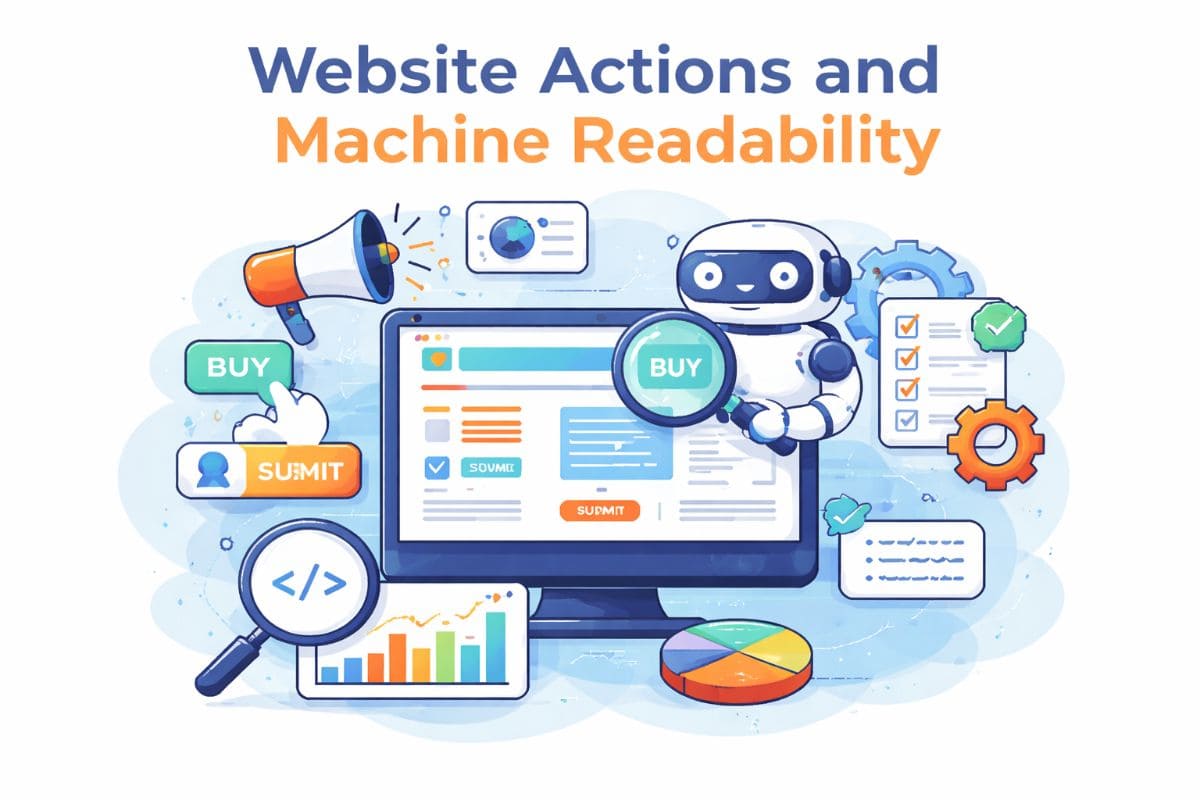
Why Your Website Actions Aren’t AI-Readable (How to Fix Them)?
Your website may load fast, rank well and convert users efficiently – but that still doesn’t mean AI systems can interact with it successfully. AI systems today are not simply reading content anymore. They are performing tasks. These tasks range from scheduling appointments to filling out forms. There is an ever-increasing expectation that AI agents will interact directly with websites.
But here is the problem:
The majority of sites are not set up for machine execution. If you don’t set up your workflows appropriately, AI systems won’t recognize your platform, no matter how effective your SEO is. This is why the concept of a machine-readable website is vital.
What Does a Machine-Readable Website Actually Mean?
A machine-readable website is not simply about content that is structurally right. A machine-readable website is also about providing structurally correct actions.
Your website needs to be able to:
- Expose workflows in a structured way
- Clearly define inputs and outputs
- Allow AI systems to perform actions in a reliable manner
Instead of trying to figure out how to perform a form’s function, AI systems will know exactly how to do it.
This approach is the basis for AI action readiness.
Why Are Your Website Actions Not AI-Readable?
AI tools currently cannot understand the actions taken on your website. It is because they were created primarily with human users in mind, rather than through machine-based means.
The main shortfalls of the current state of affairs are that:
1. UI-Dependent Workflows
Actions performed on a webpage are associated with buttons, forms and other visual elements. AI does not consistently understand UI behavior. Thus, leading to broken automated processes, inconsistent execution and poor usability.
2. Lack of Structured Input or Output Definitions
Forms are not consistently defined for what is required for inputs, what format the data is in and what type of output is expected. Therefore, AI models are not reliable for validating and executing actions.
3. No Standardized Execution Layer
The lack of a standardized execution layer hinders the efficient execution of workflows across a website. This means that AI agents must use scraping, reverse engineering or make assumptions to identify the right mechanisms to perform a task. This leads to a non-deterministic execution.
4. Fragmented Backend Logic
Business logic is often spread across multiple disconnected services with no unified APIs, making it difficult for AI systems to access workflows as cohesive processes.
5. Missing Validation & Control Systems
Without a proper system of controls, actions performed to date have been rendered insecure, unreliable and unpredictable. Therefore, there is a considerable need for AI systems to have strict validation processes to execute consistently and safely.
What Makes Website Actions AI-Readable?
To be a machine-readable structure, your website should be defined as a structured workflow.
Actions should have:
- Inputs with defined values (what it requires)
- Input format with a defined structure (how it’s structured)
- Validation rules that defined the acceptable values (what it allows)
- Execution logic to determine the next steps (what happens next)
- Outputs with structured values (What it returns)
This transforms website actions into structured, machine-executable contracts that AI systems can reliably interpret and execute.
Deterministic Execution Layers for AI Workflows
One of the biggest differences between traditional websites and AI-ready platforms is deterministic execution.
Traditional websites rely heavily on UI interaction, where users click buttons, submit forms and navigate pages manually. AI systems, however, require structured execution environments that produce predictable outcomes every time an action is triggered.
A deterministic execution layer ensures that:
- Inputs are standardized
- Validation rules are enforced
- Workflow outcomes remain predictable
- Actions can be executed securely and consistently
For example, instead of an AI attempting to visually interpret a booking form, the workflow exposes:
- Required input fields
- Accepted data formats
- Validation logic
- Structured outputs
- Execution status responses
This allows AI systems to interact with workflows programmatically rather than relying on interface-based assumptions. Frameworks like WebMCP help establish these execution layers by transforming traditional website actions into machine-readable and AI-executable workflows.
Structured Workflows vs. UI Automation
Traditional automation relies on simulating clicks, forms and user behavior through the interface layer. This approach is fragile because even small UI changes can break automation logic.
AI-ready websites use structured workflows instead.
Structured workflows expose:
- Defined inputs and outputs
- Validation rules
- Deterministic execution paths
- Machine-readable schemas
This enables AI systems to execute actions reliably without depending on visual interfaces or browser-level automation. Modern execution frameworks like WebMCP help standardize these workflows for scalable AI interaction.
How to Fix Non-Readable Website Actions
Follow these steps to help improve the AI action readiness:
1. Find Workflows That Will Provide the Most Value
Identify actions that you want to positively affect your business:
- Lead forms
- Booking systems
- Product search
- Checkout processes
These actions should be prioritized for structuring.
2. Structure Your Actions Into Machine-Readable Schemas
Establish a structured schema for each workflow by defining the following:
- Input fields
- Output responses
- Validation rules
This schema will provide a machine-readable blueprint.
3. Create an Execution Layer
Provide a structured layer of accessibility for workflows with AI systems. The execution layer should be:
- Discoverable
- Deterministically executable
- Integrable with back-end systems
4. Optimize Access to Your Data
Ensure your data is:
- Structured
- Consistent
- Accessible via API
This allows AI systems to find and retrieve information rapidly and efficiently.
5. Define Validation & Security Controls
Add mechanisms to control access to your workflows by:
- Authentication
- Rate limiting
- Role-based access control
This approach will provide for the secure and reliable execution of your workflows.
6. AI Simulation Testing
Before deploying your project, you need to run an AI simulation that performs the following:
- Simulate AI interaction
- Test output in edge cases
- Validate AI outputs
By conducting these tests, you ensure reliable execution.
Traditional Websites vs. Machine-Readable Websites
Traditional websites are:
- Built for human interaction
- Driven through UI
- Limited automation capabilities
Machine-readable websites are:
- Designed for machine execution
- Built on structured workflows
- Support scalable automation and AI interaction
This fundamental change in how we build web applications is going to dictate the future architecture of the web.
Why is This Important for SEO and Growth?
AI-driven search is evolving from information retrieval toward action-based execution.
This means:
- Users do not simply find your site
- AI will perform actions on the user’s behalf
If your workflow is not machine-readable:
- No action will be triggered
- You will lose the conversion
- Your site’s visibility will decrease
Building a machine-readable website will allow your business to continue to have access in an AI-based ecosystem.
Common Mistakes to Avoid
Avoid the following mistakes when building a machine-readable structure:
- Overcomplicating the workflow
- Overexposing low-to-no-value actionable tasks
- Ignoring the schema’s consistency
- Skipping validation layers
- Not monitoring execution
Each of the above mistakes could impact the effectiveness and reduce the reliability of AI.
The Future: Websites Transforming into Execution Platforms
Websites are transforming from:
Content Platforms ➜ Interaction Systems ➜ Execution Platforms
This new model of web architecture is:
- Content becomes discoverable
- Structure becomes executable
- AI becomes operational
This architecture is the basis for AI-native web infrastructure.
FAQs:
A machine-readable website is a site that uses structured databases and processes to allow AI systems to read and follow the data and processes from the site.
Many sites use UI-based processes that don’t include schemas for data within the UI workflow, making the data and workflows difficult for AI to read or understand.
You will need to ensure that your workflow process is structured, that you define all inputs and outputs for each action on your site and that you establish an automated infrastructure for executing workflows.
Yes. Being machine-readable allows AI to interact with your site more easily. This is becoming an increasingly important factor in getting your site found through search engines today.
AI action readiness refers to the overall integrity and reliability of your site in supporting AI-based execution across all of your workflows.
Final Thoughts!
If the actions on your website are not machine-readable, then you are missing the next generation of digital interactions.
By creating a machine-readable website, you will:
- Enable AI to execute workflows
- Automate processes
- Increase conversion rates
- Future-proof your architecture
This change has already started and businesses that are prepared and ready for this change will have a tremendous advantage over their competition.
Transform Your Website into an AI-Executable Platform
To ensure your site is machine-readable, you will need more than just basic website optimization. To accomplish this, there must be a structure for the architecture of the site, an execution layer and AI-enabled workflows.
At WebMCP, we assist companies with the transition from a traditional web-based system to an AI-executable platform with structured workflows, optimized data layers and the deployment of our WebMCP execution frameworks. This means your site will be both discoverable. This creates a scalable foundation for future AI-driven search, automation and workflow execution.
If you are ready to move away from static interfaces and take your first step down the road to creating true AI action readiness, now is the time to do something about it.